Mastering the Digital Marketing Instagram Puzzle for Cohesive Brand Storytelling
In the rapidly evolving landscape of social media marketing, visual continuity has emerged as a critical factor in audience retention and brand recognition. The concept of a digital marketing Instagram puzzle represents a strategic shift from viewing posts as isolated content pieces to treating the profile grid as a holistic canvas. This approach transforms individual squares into segments of a larger narrative, creating an immersive experience that encourages profile visits and prolonged engagement. For marketers, educators, and business owners, understanding the mechanics and aesthetic principles behind these seamless grids is essential for standing out in a saturated digital environment.
The Strategic Value of Seamless Grid Aesthetics
The primary advantage of utilizing a puzzle feed layout lies in its ability to communicate professionalism and attention to detail. When a potential follower lands on a profile, the human brain processes visual patterns faster than text. A cohesive grid signals that the account is active, curated, and trustworthy. This is particularly relevant for digital marketers who must demonstrate their own design capabilities through their personal or agency branding. Unlike standard alternating layouts, a puzzle template forces content to relate spatially to its neighbors, creating a subconscious flow that guides the viewer’s eye across the entire profile.
Beyond aesthetics, this format serves a functional purpose in content organization. It allows creators to categorize information visually without relying solely on captions or highlights. For example, a continuous background color or shape can denote a specific campaign, product launch, or educational series. This visual coding reduces cognitive load for the audience, making it easier to navigate complex information. By elevating your Instagram game effortlessly with specialized tools, professionals can maintain this high level of visual sophistication without dedicating hours to manual alignment and graphic design software.
Technical Flexibility Without Professional Design Software
Historically, creating a seamless puzzle feed required advanced proficiency in Adobe Photoshop or Illustrator. Designers had to manually slice large canvases, manage layer visibility, and ensure precise export settings to prevent white lines between posts. Modern solutions have democratized this process through browser-based platforms. Utilizing a Canva digital marketing puzzle template removes the technical barrier to entry while retaining professional output quality. These templates are engineered with pre-set dimensions and alignment guides, ensuring that when individual tiles are exported, they reassemble perfectly on the mobile app interface.
The accessibility of these tools extends to cross-platform functionality. The ability to edit templates using either the Canva website or the mobile app provides significant workflow advantages. Marketers can plan and structure their grid on a desktop for precision, then make last-minute text adjustments or image swaps via mobile while on the go. This flexibility eliminates the need for expensive software licenses and steep learning curves, allowing resources to be redirected toward strategy and community management rather than technical troubleshooting.
Customization Dynamics and Brand Consistency
A common misconception about templates is that they limit creativity or result in generic-looking feeds. However, high-quality digital marketing Instagram puzzle assets are designed as foundational frameworks rather than rigid constraints. Fully customizable elements allow users to alter fonts, shapes, colors, backgrounds, and imagery to match specific brand guidelines. This adaptability ensures that the puzzle serves the brand identity, not the other way around. Changing the color of every shape or adjusting typography hierarchy enables businesses to refresh their look seasonally or align with specific client campaigns without rebuilding the grid structure from scratch.
Furthermore, the reusability of these templates offers long-term efficiency. Once a master style is established, it can be duplicated and modified indefinitely. This creates a sustainable content production system where the visual architecture remains consistent even as the messaging evolves. For agencies managing multiple accounts, this means maintaining distinct visual identities for different clients using the same underlying structural logic. The capacity to resize elements and modify individual components ensures that each post retains its integrity both as part of the larger puzzle and as a standalone piece of content in the main feed.
Streamlining Content Production Workflows
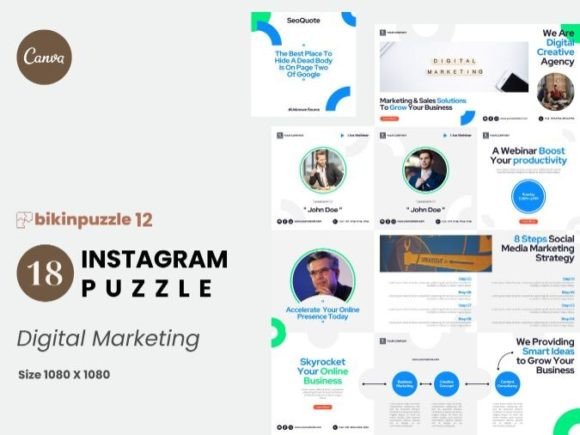
Time management is often the most significant bottleneck in social media marketing. Creating visually stunning grids that captivate your audience in seconds is only possible through systematic workflows. A comprehensive set of 18 design Canva templates for Instagram puzzle provides enough variety to cover weeks of content planning while maintaining thematic unity. This volume allows for diverse content types—quotes, statistics, promotional graphics, and lifestyle imagery—to coexist harmoniously within the same visual ecosystem.
The efficiency gained from using pre-structured layouts compounds over time. Instead of staring at a blank canvas for every new post, marketers start with a proven composition. This shifts the creative energy from layout design to message refinement. Additionally, having a library of compatible templates facilitates batch creation. Users can populate an entire month’s worth of content in a single session, ensuring that the puzzle connections remain intact and that the overall feed rhythm is preserved. This proactive approach prevents the disjointed appearance that often results from ad-hoc posting schedules.
Implementation Protocols and Asset Management
Successfully deploying a puzzle feed requires understanding the specific operational workflow associated with template-based design. The process begins with acquiring the necessary assets. After purchasing a digital marketing Instagram puzzle package, users typically receive an access file containing direct links to the editable source material. This delivery method ensures immediate access and avoids compatibility issues associated with downloading heavy raw files. Clicking the access link integrates the templates directly into the user’s Canva workspace, preserving all layers, groups, and smart mockups.
Once inside the editor, the customization phase involves more than simple text replacement. Effective implementation requires reviewing the instruction manual included with the template set. These guides often contain crucial tips on maintaining alignment, exporting settings, and best practices for uploading sequential posts. Understanding these nuances prevents common errors such as misaligned seams or compressed image quality. The manual serves as a bridge between owning the asset and mastering its application, ensuring that the final output matches the professional standard demonstrated in the preview.
Optimizing Individual Posts Within the Collective Grid
While the aggregate effect of a puzzle feed is powerful, each individual tile must still function independently. Followers viewing a single post in their home feed will not see the surrounding context. Therefore, the design must balance collective cohesion with individual legibility. When customizing a digital marketing Instagram puzzle, it is vital to ensure that key text and focal points remain centered within the safe zone of each square. Background elements and decorative shapes can extend to the edges to create the seamless connection, but critical information should never be split awkwardly across tiles unless intentional artistic cropping is employed.
This dual-purpose design requirement necessitates careful consideration of contrast and hierarchy. Colors that work beautifully across three merged tiles might lack sufficient contrast when viewed as a solitary image. Testing designs in isolation before publishing is a recommended best practice. The fully customizable nature of modern templates allows for micro-adjustments to brightness, saturation, and element placement to satisfy both macro and micro viewing contexts. This attention to detail distinguishes amateur attempts from professional executions, reinforcing the credibility of the digital marketer or brand.
Scalability and Long-Term Visual Strategy
Adopting a puzzle feed strategy is not merely a tactical decision for short-term engagement; it is a foundational element of long-term brand architecture. The ability to use templates repeatedly supports scalability as businesses grow. As product lines expand or services evolve, the visual system can adapt without losing recognition. New templates can be introduced gradually alongside existing ones, provided they share core design DNA such as color palette, typeface selection, and geometric language. This evolutionary approach keeps the feed fresh while maintaining the trust built through visual consistency.
Moreover, the data-driven aspect of digital marketing benefits from structured visual testing. Because puzzle templates standardize the design variables, marketers can more accurately isolate the impact of content topics versus visual presentation. If engagement spikes during a specific puzzle sequence, it becomes easier to determine whether the success was driven by the subject matter or the visual arrangement. This analytical clarity is difficult to achieve with disparate, unconnected post designs. By integrating these templates into a broader marketing strategy, professionals gain both aesthetic appeal and actionable performance insights.
Support and resource availability also play a role in sustainable usage. Access to creator support for troubleshooting or customization advice ensures that technical hurdles do not derail content calendars. Whether resolving a formatting issue or seeking guidance on extending the puzzle beyond the initial 18 templates, direct communication channels enhance the utility of the asset. This relationship between tool and user fosters a deeper understanding of digital design principles, ultimately empowering marketers to create increasingly sophisticated visual narratives that resonate with their target audiences across all touchpoints.