Designing with the Tennis Player Silhouette Black Vector: A Comprehensive Guide for Visual Communication
The Strategic Value of EPS Vector Silhouettes in Sports Media
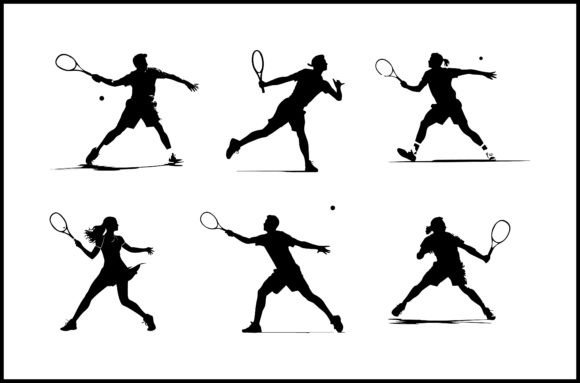
In the realm of sports graphic design, few assets offer the immediate recognition and versatility of a Tennis Player Silhouette Black Vector. While raster images serve specific photographic needs, the vector format stands apart as the industry standard for scalable, editable, and timeless visual communication. When designers and content creators search for a tennis player silhouette black vector, they are typically seeking more than just a shape; they are looking for a foundational design element that can be manipulated without loss of quality across mediums ranging from business cards to stadium banners.
The primary advantage of obtaining an EPS (Encapsulated PostScript) vector silhouette lies in its mathematical construction. Unlike pixel-based clipart, which degrades when enlarged, a Tennis athlete vector maintains crisp edges at any resolution. This is critical for professional applications where branding consistency is paramount. Whether applied to a small Tennis icon set for a mobile application or expanded into massive Tennis match graphics for arena signage, the integrity of the line work remains intact. Furthermore, the black silhouette serves as a neutral canvas, allowing designers to apply brand-specific colors, gradients, or textures within the vector software, making it a chameleon-like asset in the designer’s toolkit.
Categorizing Action: From Serve Silhouettes to Victory Poses
A generic standing figure rarely captures the kinetic energy inherent to the sport. Effective Tennis graphics rely on dynamic posing that communicates movement, tension, and athleticism. When selecting or creating a Tennis action silhouette, it is essential to categorize assets based on the specific narrative they convey. The biomechanics of tennis provide distinct visual cues that knowledgeable audiences recognize instantly.
- Tennis Serve Silhouette: Perhaps the most iconic pose in the sport, the serve represents power and initiation. A well-crafted Tennis serve silhouette captures the trophy position or the full extension of the racket arm. This graphic is frequently used in Tennis championship clipart and promotional materials for major events, symbolizing the start of competition and peak athletic performance.
- Tennis Backhand Graphics and Forehand Icon Set: Technical accuracy matters. A two-handed backhand looks distinctly different from a one-handed slice in silhouette form. Designers working on instructional content or Tennis technique icon set projects must ensure anatomical correctness. These specific Tennis player vectors are invaluable for coaching academies and educational platforms where distinguishing between stroke types is necessary for visual clarity.
- Tennis Victory Silhouette: Emotional resonance is as important as technical depiction. A Tennis victory silhouette often features raised arms, a fist pump, or a leap. These are staples in Tennis slam clipart and post-match reporting, serving as visual shorthand for success, relief, and triumph.
- Tennis Doubles Graphics vs. Singles Icon Set: Composition changes based on player count. Tennis doubles graphics require careful attention to negative space between figures to prevent them from merging into an unrecognizable blob. Conversely, a Tennis singles icon set focuses on individual isolation and center-stage presence.
Applications in Coaching, Education, and Academy Branding
Beyond commercial advertising and event promotion, the Tennis player silhouette black vector plays a pivotal role in education and training environments. Visual learning is a cornerstone of athletic development, and simplified graphics often communicate complex mechanical concepts more effectively than video or photography by removing distracting background noise.
Tennis coaching graphics utilize silhouettes to highlight body alignment, racket head position, and footwork patterns. Because a silhouette removes facial features and clothing details, the viewer’s focus is forced entirely onto the geometry of the movement. This makes Tennis training silhouette assets ideal for drill manuals, whiteboard breakdowns, and digital analysis tools. A Tennis coach clipart might be depicted pointing or demonstrating, while a Tennis practice silhouette shows repetitive motion or specific Tennis drills clipart scenarios like volley exchanges or baseline rallies.
For institutions, these vectors form the backbone of identity. A Tennis academy vector package often includes not just players, but supporting elements like a Tennis net silhouette or Tennis court design elements. These environmental graphics help establish context without requiring photorealistic rendering. When combined with a Tennis equipment icon set featuring rackets, balls, and bags, academies can create comprehensive wayfinding systems, merchandise designs, and curriculum visuals that feel cohesive and professional. The use of consistent Tennis sport vector styles across all touchpoints reinforces brand recognition and signals organizational competence to prospective students and parents.
Technical Considerations for EPS Integration
While the aesthetic appeal of a Tennis player outline is subjective, the technical quality of the file is objective. Not all vectors are created equal, and understanding the nuances of EPS files ensures smoother workflows. When sourcing a Tennis player silhouette black vector, professionals should evaluate several key characteristics to ensure the asset is production-ready.
First, examine the node structure. A high-quality Tennis player vector should have clean, optimized paths with minimal anchor points. Excessive nodes can result in jagged curves when scaled and make editing difficult. Second, verify that the silhouette is a closed path. Open paths can cause issues when applying fills or exporting to different formats like SVG or PDF. Third, check for grouping and layering. Well-organized Tennis clipart files separate the player, the racket, and the ball into distinct layers or groups. This modularity allows designers to swap out a Tennis racket silhouette or adjust the angle of a Tennis ball clipart without redrawing the entire composition.
Compatibility is another factor. While EPS is a universal standard, variations exist between versions created in Adobe Illustrator, CorelDRAW, or free alternatives like Inkscape. Ensuring your Tennis competition vector opens correctly in your preferred software prevents workflow bottlenecks. Additionally, consider the licensing implications. A Tennis league vector intended for commercial merchandise requires different rights than one used for an internal school newsletter. Always verify that the Tennis player silhouette black vector you acquire permits your specific intended use case.
Expanding the Visual Vocabulary: Equipment and Environment
A solitary figure can sometimes feel disconnected. To create compelling compositions, designers often pair the Tennis player silhouette black vector with complementary environmental and equipment graphics. This contextualization transforms a simple icon into a complete scene.
The Tennis court design elements are particularly useful for grounding the player. Perspective lines, service boxes, and baseline markers provide spatial reference. When integrating a Tennis fitness vector showing agility drills, overlaying court lines helps viewers understand the scale and intensity of the movement. Similarly, a Tennis net silhouette adds depth and separation, useful in Tennis tournament graphics where distinguishing between sides of the court is visually relevant.
Equipment icons serve as functional accents. A Tennis equipment icon set might include stylized rackets, wristbands, shoes, and trophies. These smaller elements balance the visual weight of a large Tennis action silhouette. For example, in a Tennis skills graphics infographic, a large forehand silhouette might be surrounded by smaller icons representing grip strength, spin rate, and speed. This hierarchy guides the eye and breaks up dense information. Even abstract elements like motion lines or impact bursts, often found in Tennis game icon set collections, can enhance the perception of speed and force in a static Tennis player outline.
Versatility Across Digital and Print Mediums
The true test of any Tennis player silhouette black vector is its adaptability. In the digital sphere, these assets are lightweight and responsive. A Tennis icon set derived from silhouettes loads quickly on websites and scales perfectly for retina displays. They function excellently as app icons, social media avatars, or navigation markers. The solid nature of a silhouette ensures legibility even at favicon sizes, where detailed illustrations would fail.
In print, the advantages shift toward cost-efficiency and impact. Single-color printing is significantly cheaper than full-color process printing. A bold Tennis player silhouette black vector printed on t-shirts, tote bags, or stickers requires only one ink pass, reducing production costs for Tennis club clipart merchandise. On large-format media like vinyl decals or mesh fences, the infinite scalability of the vector ensures that a Tennis teamwork silhouette looks sharp whether it is six inches or sixty feet wide. This cross-medium reliability makes the EPS vector silhouette an indispensable asset for anyone involved in tennis-related visual production, from independent hobbyists crafting custom gear to global brands managing international campaigns.
Ultimately, the enduring popularity of the Tennis player silhouette black vector stems from its unique intersection of art and utility. It distills the complexity of human motion into its purest graphical form, stripping away the superfluous to reveal the essential. Whether used to teach a proper backhand, sell tickets to a grand slam, or simply decorate a laptop lid, these vectors bridge the gap between the physical reality of the sport and the digital landscape of modern design. By understanding the technical specifications, categorical variations, and strategic applications of these assets, creators can leverage the full potential of Tennis sport vector imagery to communicate with precision, style, and enduring relevance.